The boom, in real numbers
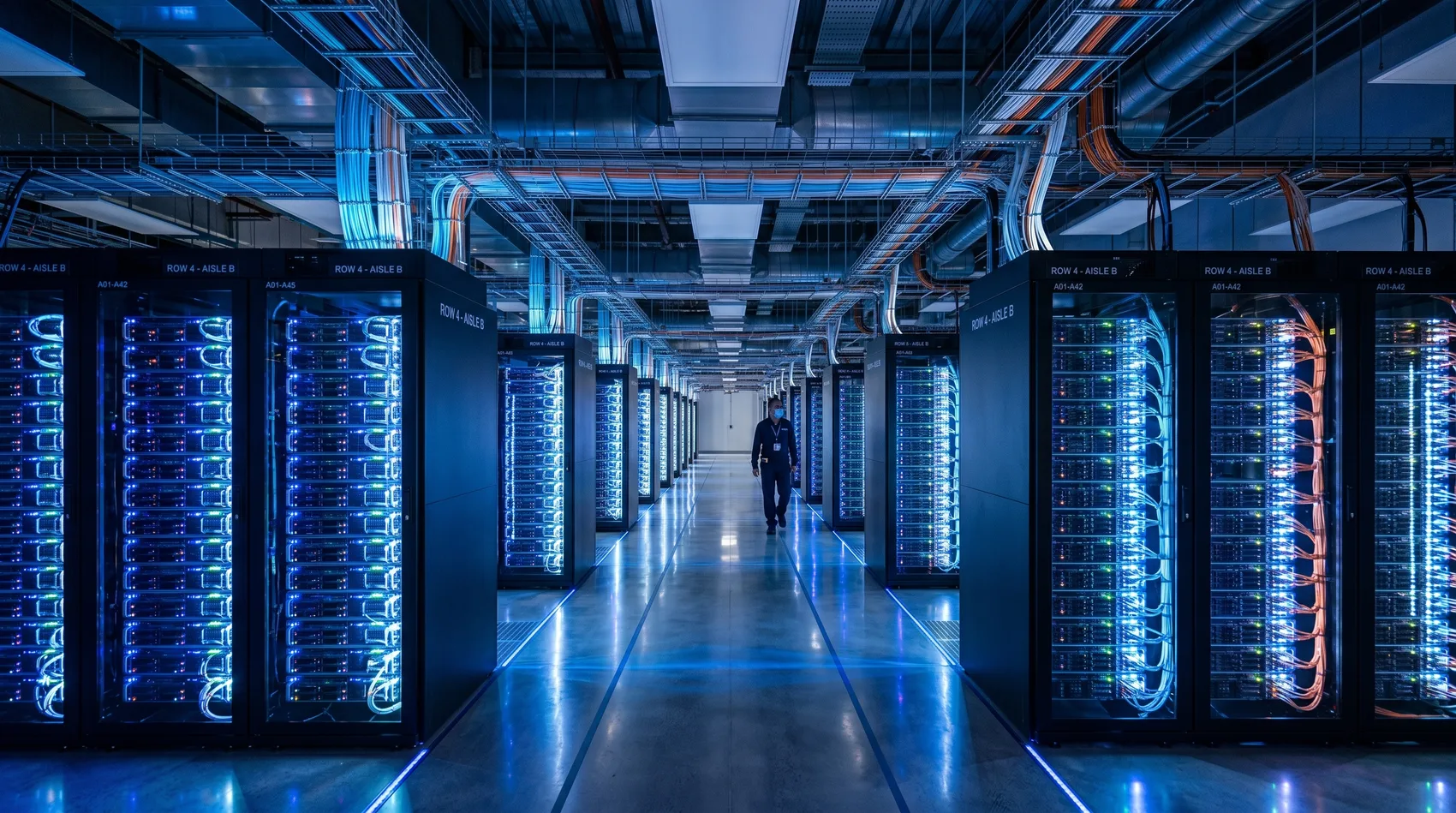
The AI build-out has turned data centers into the most capital-intensive construction story in the country. U.S. data center power demand is projected to climb from ~31 GW in 2025 toward ~66 GW by 2027 — roughly a doubling in two years. Annual capacity additions rise from ~8.5 GW in 2025 to ~13.6 GW in 2026. Construction spending hit ~$49.5B year-to-date through April 2026, up from ~$13.6B in the same window a year earlier.
Translation for the trades: a historic, multi-year pipeline of mission-critical work — and a severe shortage of crews who can execute it.
Why Northwest Indiana is ground zero
Indiana has quietly become one of the most active data center markets in the nation. AWS's "Project Rainier" in New Carlisle is an ~$11B campus targeting ~1 GW online; a November 2025 AWS commitment adds ~$15B in new Northwest Indiana campuses, and Meta broke ground on a ~$10B Indiana data center in early 2026. Statewide, there are dozens of planned projects representing more than 15,000 MW in the queue.
For contractors in the Hebron / Valparaiso / Lake & Porter County corridor, this is a once-in-a-generation concentration of mechanical and structural work — right in the backyard.
What makes these buildings hard to build
A data center looks like a big box. It builds like a power plant crossed with a precision factory. Three systems drive the complexity:
1. Power
Mission-critical power is the long pole — large transformer lead times now stretch up to ~4 years, and grid interconnection queues are so backed up that a meaningful share of planned capacity is expected to slip.
2. Cooling — the mechanical story
AI racks run hot, so 2026 is the year liquid cooling went mainstream. Direct-to-chip cooling is effectively standard, and systems now support up to 250 kW per rack. All that heat means miles of mechanical piping: chilled-water supply and return, condenser water, glycol and economizer loops, and the Coolant Distribution Units (CDUs) and overhead manifolds that must be welded clean, supported correctly, and pressure-tested before they ever see a server.
3. The MEP reality
The line every owner now understands: MEP systems can be 70%+ of construction cost. The shell is the easy part. The value — and the risk — is in the mechanical scope that depends on skilled welding and fabrication.
Prefabrication moves the work — it doesn't remove it
To beat the schedule, the industry is shifting work off the jobsite into the shop: prefabricated, skid-mounted pump and cooling-loop modules built and tested while site work happens in parallel. But prefab doesn't remove welding and fabrication — it moves and multiplies it. Someone has to build repeatable skid frames, weld and pressure-test the loops, fabricate the supports and structural steel, and field-weld the final tie-ins when modules land.
The real bottleneck is execution capacity
The defining constraint in 2026 isn't steel or copper — it's whether you can reliably staff and finish the work. The vast majority of construction firms report trouble filling craft positions, specialized MEP leaders are booked 12–18 months out, and a commissioning delay on a 60 MW hall can cost a developer ~$14.2M per month. The schedule is only as strong as your weakest subcontractor.
Where welding & fabrication fit on a data center job
When people picture a data center, they think servers. When we look at one, we see the steel and pipe that keeps those servers alive:
- Chilled-water & glycol cooling piping — loops, risers, branch runs, equipment tie-ins
- Pipe supports, hangers, racks and seismic bracing
- Equipment skids & frames — pump skids, CDU/manifold supports, tank and generator bases
- Structural steel & miscellaneous metals — platforms, mezzanines, dunnage, reinforcement
- Stainless & specialty fabrication for water treatment and clean loops
- Safety & access steel — stairs, handrail, guards, ladders, catwalks
- Field welding, install, and shutdown tie-ins connecting prefab modules to the building
This is bread-and-butter industrial welding and fabrication — welded to your WPS, backed by on-site inspection and X-ray-quality welds, done to spec on a mission-critical schedule with the documentation owners expect.
How Sons of Thunder helps builders & MEP contractors
We're an industrial welding and fabrication crew built for exactly this work — based in Hebron, Indiana, serving Northwest Indiana and the Chicagoland corridor. We partner with general and mechanical contractors as the welding/fab arm that mans the job and finishes it:
- A team with capacity — crew plus trusted welders, structured to staff and run real scope
- AWS-certified welders, OSHA 10/30 trained, fully insured and bonded
- Shop fabrication + field welding — we build and pressure-ready in the shop and handle on-site install and tie-ins
- Proven mechanical scope — glycol/chilled-water tie-ins, stainless fabrication, heavy structural, supports and safety steel
- Reliability built in — we don't cut corners, we don't ghost jobs, and we close out clean
Figures current as of June 2026; sources include Goldman Sachs Research, BloombergNEF, JLL, Data Center Frontier, NWI Times, and Dell'Oro. Refreshed quarterly.